Lower back and hip pain after birth: gentle ways to find relief
Many new mothers feel aches in the lower back, hips or the area around the tailbone. Your body has carried a baby for months, given birth, and now spends hours lifting and feeding. The good news is that for most women these aches ease with time, rest and gentle movement.
This article is for informational purposes and does not replace medical advice from your midwife, OB-GYN, or pelvic floor physical therapist.
Why it happens
During pregnancy the hormone relaxin helps the joints and ligaments in your pelvis become more flexible to make room for your baby. Your posture also changes as your belly grows, and the muscles of your core and pelvic floor are stretched.
After birth it takes time for all of this to settle. Add the bending, lifting and sitting of baby care, and it is easy to see why the lower back and hips can feel tired.
Gentle movements that help
Child's pose: kneel with your knees wide, sit back towards your heels and rest your forehead on a cushion. Breathe slowly into your lower back for a minute.
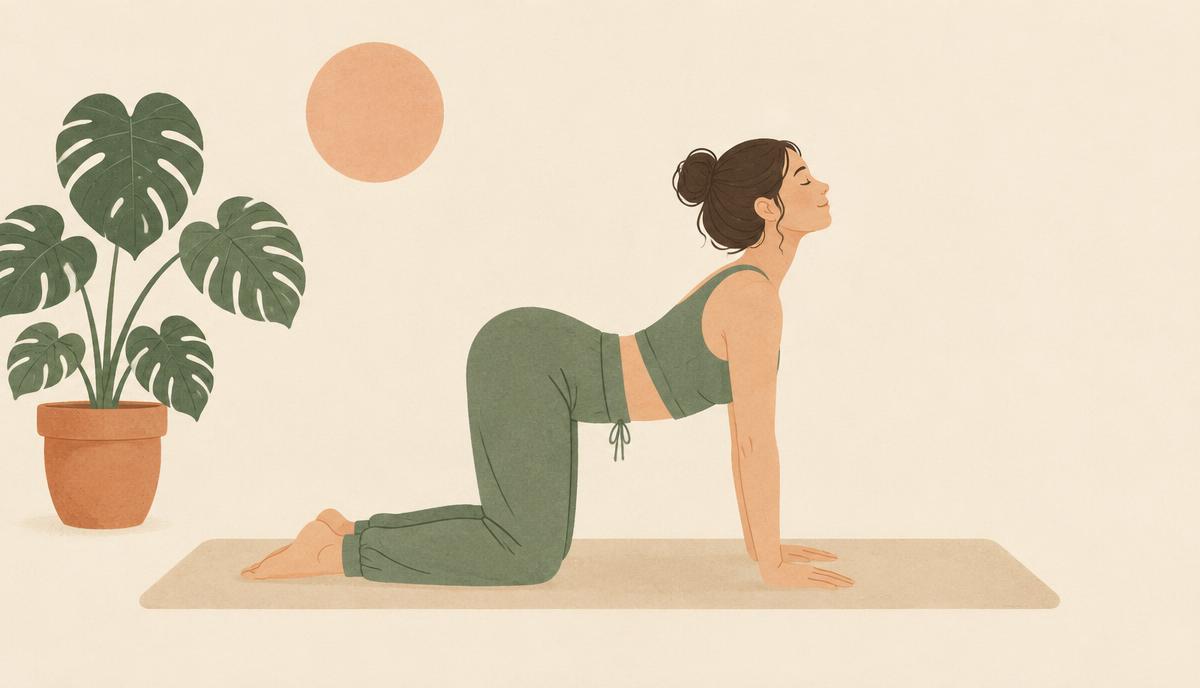
Cat-cow: on hands and knees, slowly round and gently arch your back with your breath, five to eight times.
Knees side to side: lying on your back with knees bent and feet wide, let both knees fall gently to one side, then the other.
Supported bridge: lift your hips and place a firm cushion or yoga block under your lower back. Rest here for a few breaths.
Small daily habits
Sit with your back supported when feeding, bend your knees when you lift, and switch the side you carry your baby on. Keep your knees close together when getting in and out of the car or bed, which can ease pain at the front or back of the pelvis.
A warm shower or a heat pack on your lower back can feel soothing at the end of the day.
How yoga can support your back
Slow, gentle yoga is a good match for back and hip pain after birth, because it combines easy movement with calm breathing. Poses like child's pose, cat-cow, a supported bridge and lying on your back with your legs resting on a chair can ease tension without strain.
Move only in a range that feels comfortable, and skip deep twists and big backbends in the first months. Your joints can still feel loose after pregnancy, so steady and supported is better than far and deep.
A short practice of ten minutes, done most days, usually helps more than one long session a week.
When to get help
See your doctor or a women's health physiotherapist if pain is sharp, keeps getting worse, wakes you at night, spreads down your leg, or makes walking or turning over in bed hard. Pain at the front of the pelvis, called pelvic girdle pain, is common and responds well to treatment.
Get urgent help if you have numbness around your bottom or groin, or new trouble controlling your bladder or bowels.
Frequently asked questions
Why does my lower back hurt after giving birth?
Pregnancy stretches and weakens the core, joints stay looser for a while, and feeding and carrying a baby add new strain.
Can yoga help postpartum back pain?
Slow, gentle yoga such as child's pose, cat-cow and a supported bridge can ease tension. Avoid deep twists and big backbends at first.
When should I see a doctor about back pain after birth?
See your doctor or a physiotherapist if pain is severe, sharp, spreads down your leg, or does not improve after a few weeks.
The 12-week postpartum program
Twelve weekly practices, wisdom talks, two yoga nidra sessions and week-by-week recovery guidance.
See the program